In this article
A rollout date can make a project look settled while its most important question remains unanswered: what exactly is being introduced, for whom, and by whose authority? A useful program charter answers that question before it turns into an enrollment spreadsheet. The charter is a short working agreement among the employer’s own teams. It is not a replacement for the provider’s program documentation, an employee election, or a legal review.
Corpay describes PayCard as a payroll solution. That establishes a starting point for research, not the scope of a particular employer’s implementation. The employer still needs to define its payment purpose, participating business units, responsible teams, and proposed first operating period. Program-specific conditions belong in the verified implementation materials.
Begin with the decision, not the feature list
Imagine Riverbend Fabrication, a fictional company with two established plants and a recently acquired repair operation. Its sponsor says, “Let’s launch across the business next month.” Payroll hears two familiar payroll populations. Human resources hears every employee. The acquisition manager assumes the repair operation is included even though its records and local processes are still being assessed. Each interpretation is reasonable, but the combined project is not yet defined.
Riverbend’s project lead rewrites the opening sentence: “This proposed first phase evaluates a payroll-card option for the two established plants under the existing payroll process.” That sentence does less promising and more work. It identifies the proposed purpose and deliberately names the organizational boundary. A separate line records the acquired operation as a later decision, with an owner and the evidence needed before it can be considered.
Use six fields that force useful conversations
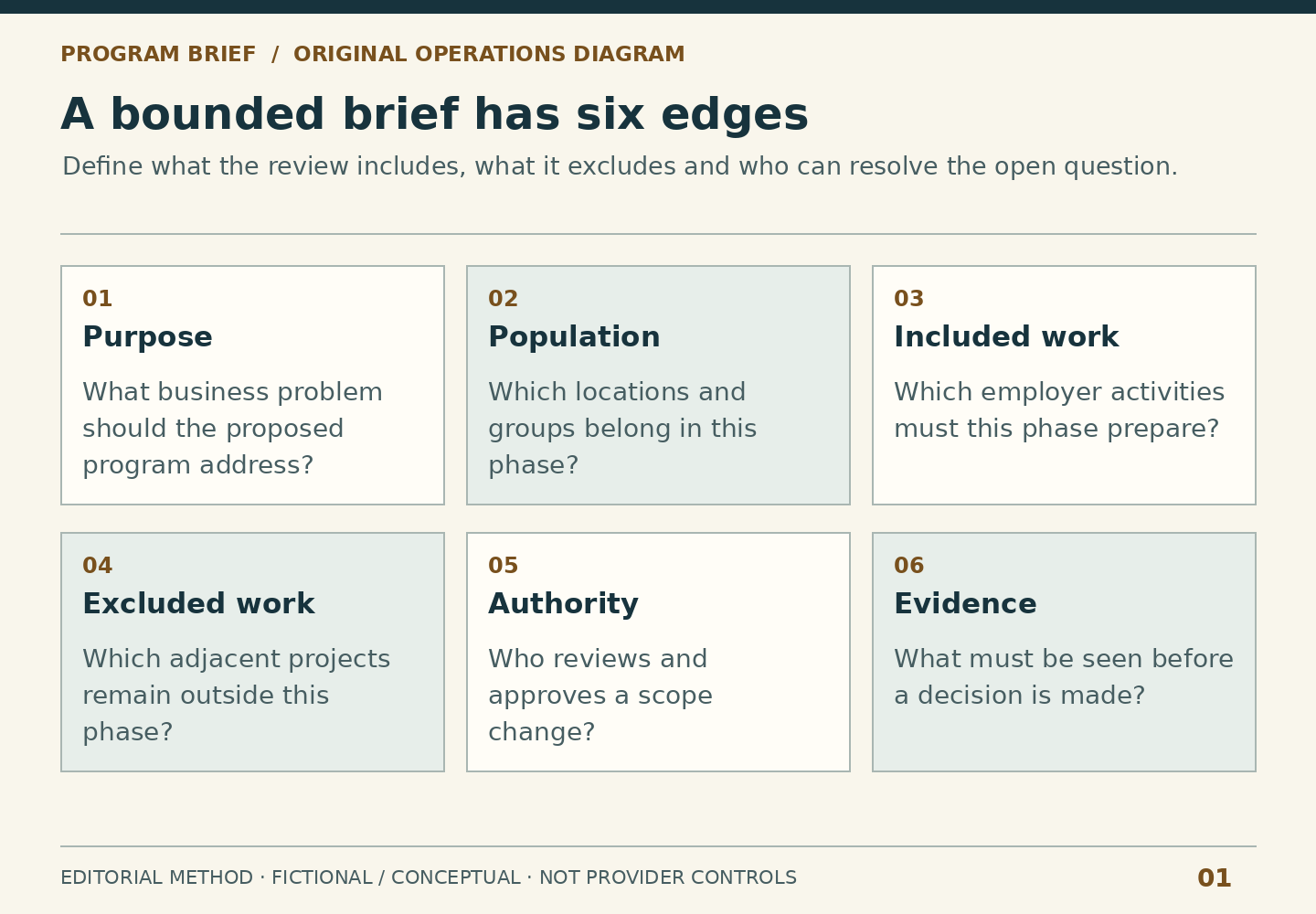
- Purpose: Describe the operating problem in employer terms. For example, reduce avoidable manual handling of a currently supported payment workflow. Do not declare a savings figure before establishing a baseline.
- Population boundary: Name the business units, locations and relevant employment groups being considered. Have the appropriate internal reviewers assess whether the proposed scope and process are suitable.
- Included work: List the employer activities this phase must prepare, such as approved communications, staff training, enrollment coordination and exception routing.
- Excluded work: Identify adjacent projects that are not included. A benefits-system change or acquisition cleanup should not silently become a prerequisite owned by this team.
- Decision authority: Name the person or role who can approve scope changes, plus the reviewers whose input is required.
- Evidence of readiness: State what the team must see before deciding whether to proceed. A calendar milestone alone is not evidence.
These fields are deliberately practical. They do not attempt to decide wage-payment obligations, consent requirements or program eligibility. Where those questions arise, record the exact question, the relevant location or population, and the qualified reviewer. The charter should expose a dependency rather than conceal it behind a general sentence saying that compliance will be handled.
Separate assumptions from approved facts
Riverbend’s early draft says that local supervisors will distribute materials. That is an assumption until plant leadership confirms staffing, language needs and an accessible way to reach every affected shift. The project lead marks it “proposed” and assigns a check date. This small distinction prevents a planning convenience from becoming an instruction that no one actually accepted.
Use three labels: confirmed, proposed and unresolved. Every unresolved item needs a question rather than a vague topic. “Communications” is not a question. “Who will make the approved material available to employees on the overnight shift, and how will receipt of that material be checked without collecting account information?” gives the team something it can resolve. Keep supporting evidence in the appropriate restricted workspace, with the charter pointing to the approved record rather than copying personal data.
Make changes visible without freezing the project
A scope charter should allow learning. It should not make every small correction into a steering committee meeting. Riverbend distinguishes a clarification from an expansion. Correcting a location’s display name is a clarification. Adding the acquired repair operation, another payment purpose or a new data-transfer route is an expansion. Expansions require the owner to assess consequences for preparation, review and timing before the charter changes.
A compact change entry can contain the request, its reason, the affected work, the approving role and the date of the decision. Keep the previous version available under the employer’s normal records practices. The important outcome is that a supervisor reading this week’s charter sees the same boundaries as the payroll analyst preparing next week’s activity.
A first-page charter you can adapt
Proposed outcome: Prepare and assess a defined payroll-card rollout for the named first-phase locations. Current boundary: Two established plants; the acquired operation remains under separate review. Readiness evidence: Approved program materials, resolved operating ownership, completed staff exercises and a reviewed exception path. Open decision: Whether both plants can enter the same phase. Decision owner: The employer’s designated program sponsor, after the required specialist reviews.
Before circulating that page, ask three people to explain it back: a sponsor, a frontline manager and someone who will perform the daily work. If they describe different populations or a different first-phase outcome, revise the charter. A scope document earns its place by reducing those differences before they become operational commitments.
Source boundary
These are original editorial methods and fictional examples, not provider instructions or launch approval. Public sources supply the narrow product or general-practice context identified beside the linked claim.
- Corpay PayCard product overview · checked October 13, 2026