In this article
Two teams can choose to investigate products from the same provider and still be solving different problems. The risk is not the shared name on the presentation. It is the shared project folder in which different payment purposes gradually inherit each other’s approvals, audience lists and instructions. A separate program brief creates a useful boundary before that confusion reaches an operating team.
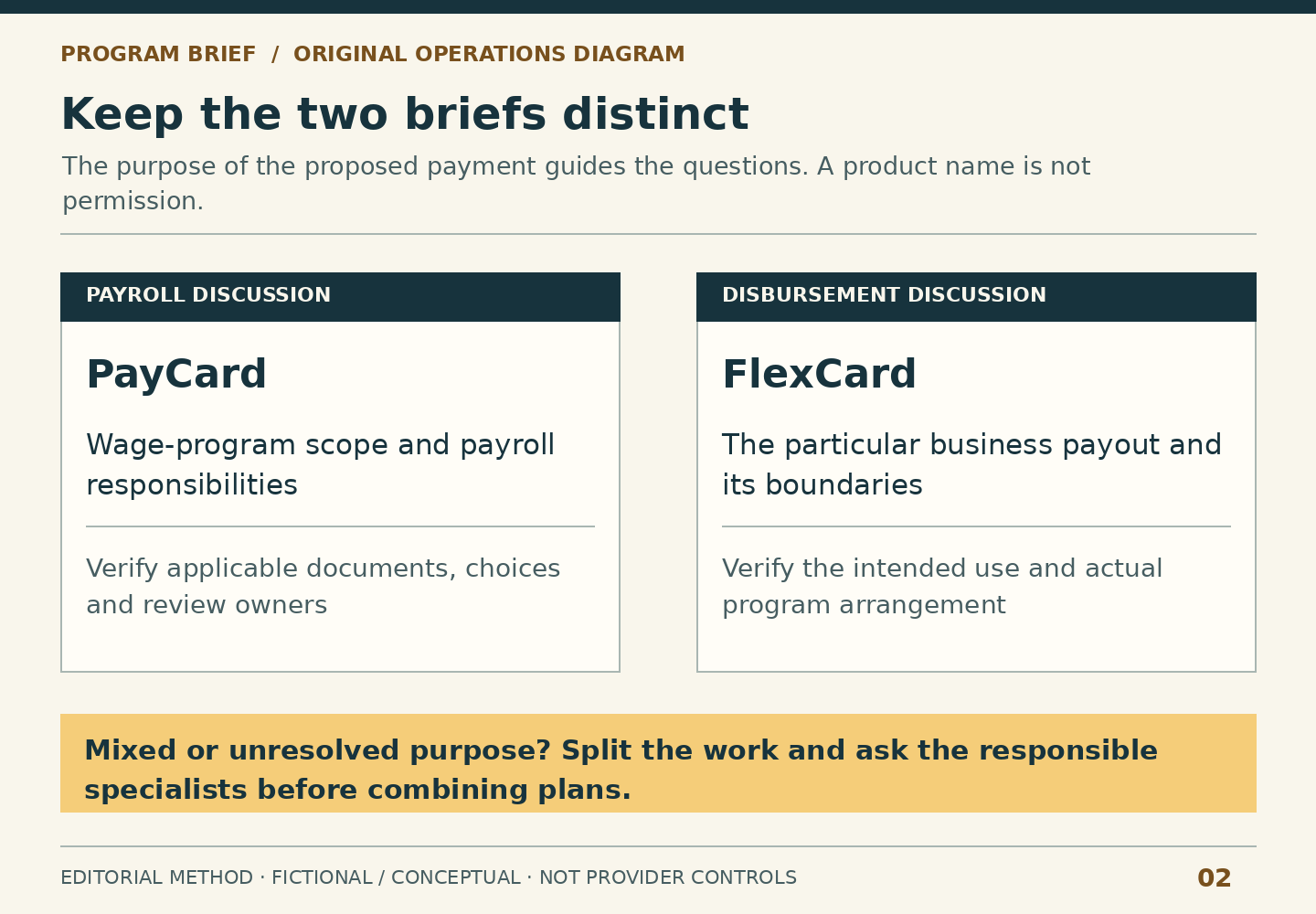
Corpay’s official pages present PayCard for payroll and FlexCard for business disbursements, including several nonpayroll use cases. Those descriptions help frame questions. They do not decide how a particular payment must be classified, reported or administered. The employer’s qualified payroll, accounting and legal reviewers should resolve those questions for the actual facts.
Give each brief its own starting sentence
Alder & Finch Distribution is a fictional employer evaluating a payroll-card program. During a planning meeting, another department asks whether the same initiative can cover a separate business-payout project. The sponsor welcomes the efficiency. Soon the draft says “card rollout” throughout, and no one can tell which decisions apply to which activity.
The project lead creates two briefs rather than two entirely separate organizations. The payroll brief starts with the wage-payment purpose and its responsible payroll owner. The other brief starts with a specific proposed business-disbursement purpose and its own business owner. Shared procurement or security work may be linked from both. The briefs do not share an approval merely because the same person attends both meetings.
This distinction is an editorial planning method. It does not claim that either product requires a particular document or that every employer needs a new committee. Its purpose is to make the employer’s reasoning readable and testable.
Build a purpose-and-authority record
For each brief, write down the business reason for the payment, the group involved, the department authorizing the underlying amount and the process that creates the authoritative payment record. Then identify who is allowed to approve release within the employer’s established arrangements. A person who can explain an amount is not automatically the person who can authorize a payment.
Do not resolve ambiguity by using a familiar label. Calling something a reward, allowance or contractor payment does not settle its legal or accounting treatment. If classification is unresolved, describe the actual activity and route the question for review. Keep the implementation decision open until the relevant facts are established. The card product is a possible delivery mechanism; it is not a substitute for determining what the employer is paying.
Compare the right questions side by side
- What creates the payment obligation or approved business purpose?
- Which employer record is authoritative for the amount and recipient population?
- Who reviews the underlying calculation or approval?
- What program-specific documentation governs the proposed route?
- Which communications and internal training materials belong to this use case?
- Where will exceptions be received, and who can decide the next employer action?
- What facts must be confirmed before the team commits to timing?
Answer these questions separately even when some answers match. At Alder & Finch, the security team may review a shared vendor relationship, while payroll and the other business function maintain distinct authorization records. That is a meaningful overlap. Copying the payroll audience into the other project because the spreadsheet already exists is not.
Reuse work by reference, not by assumption
The strongest efficiency comes from identifying an approved shared component. For example, both projects may point to the organization’s current privacy review or vendor contact directory. Each brief should say why that component applies and who confirmed it. If one project uses a different data route or operating team, the existing review may need further work. A shared logo does not make the changed facts disappear.
Communication drafts deserve special care. A payroll notice should not borrow statements about another disbursement program’s delivery or access process. Equally, a business-payout notice should not adopt payroll terminology simply because employees recognize it. Use the exact approved program name and verified materials for the intended audience. Where the team has not verified a feature or condition, leave a review question instead of filling the gap with marketing language.
Hold a boundary check before combining milestones
Alder & Finch initially proposes a single launch meeting. The project lead asks each owner to bring the approved purpose, unresolved dependencies and evidence required for a decision. The payroll work is ready for a rehearsal; the other initiative still needs its recipient population and underlying authorization process confirmed. One combined meeting would make the less mature project appear more ready than it is.
The team retains a common coordination meeting but gives each brief an independent readiness decision. Shared tasks remain visible, and either workstream can pause without implying that the other has failed. This makes accountability clearer while preserving useful collaboration.
The finished artifact
A good pair of briefs fits a simple pattern: purpose, population, authoritative record, approval ownership, proposed product, open specialist questions, operating evidence and next decision. Add a final sentence identifying which shared work has actually been confirmed as reusable. Anyone reading the pair should be able to say where the programs overlap, where they differ and which assumptions still require review.
The result is not bureaucracy for its own sake. It is a way to prevent an employer from approving one thing while its teams prepare another. Keep the purpose visible, and the product conversation becomes substantially easier to evaluate.
Source boundary
These are original editorial methods and fictional examples, not provider instructions or launch approval. Public sources supply the narrow product or general-practice context identified beside the linked claim.
- Corpay PayCard product overview · checked October 13, 2026
- Corpay FlexCard product overview · checked October 13, 2026