In this article
A rollout spreadsheet tends to grow by accumulation. Someone adds a column because a previous project used it. Another person copies a full employee export because removing fields takes time. By the time the file is ready to send, the team can explain where the data came from but not why every field is necessary. The right moment to fix that problem is before a real record enters the handoff.
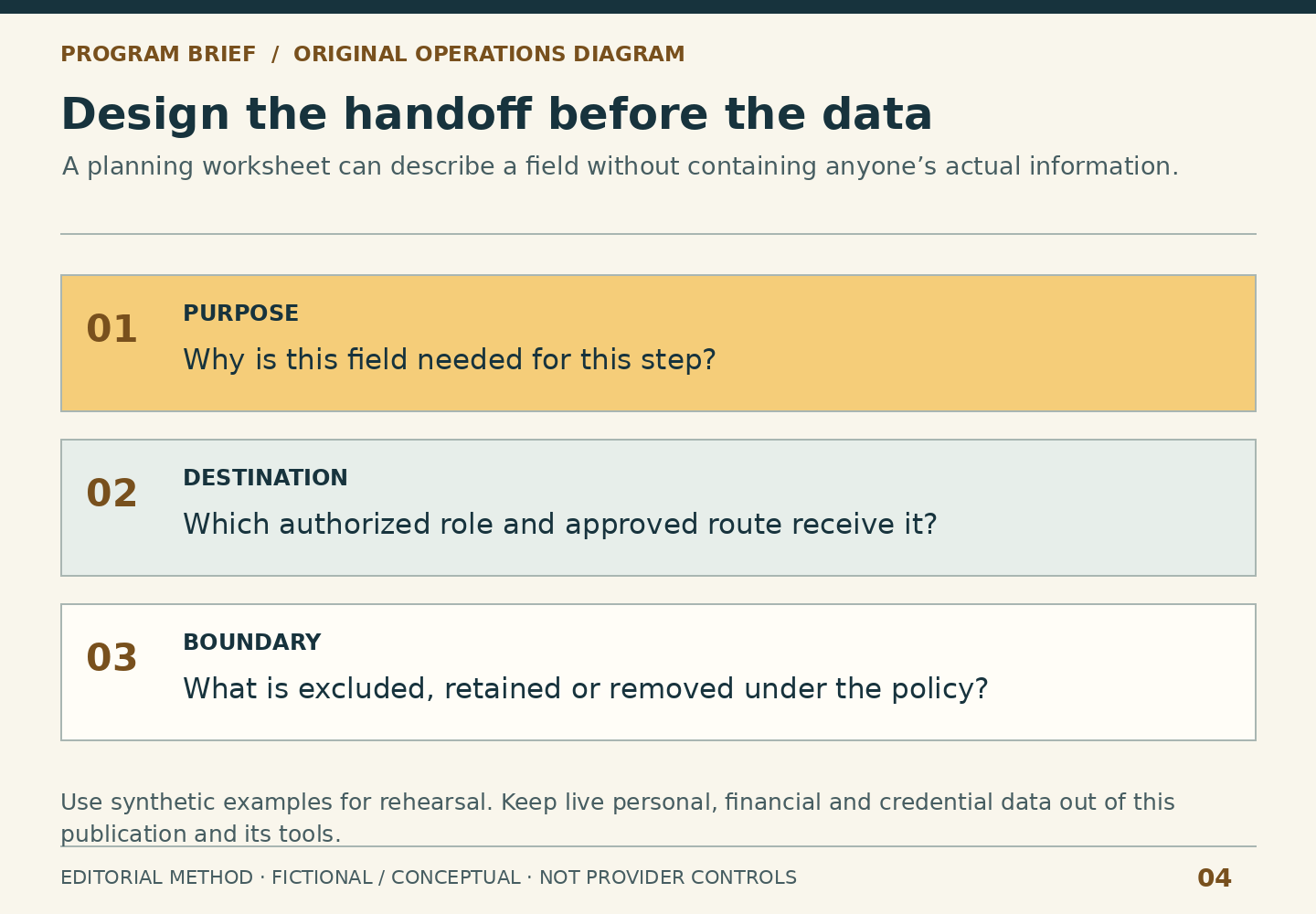
The Federal Trade Commission’s business guidance emphasizes understanding information flows, limiting retained information and protecting what is kept. The specification below is an original employer planning tool informed by those broad principles. It is not a description of Corpay’s technical requirements, a security certification or a complete privacy-compliance assessment.
Start with the receiving purpose
Fictional Cedar Ridge Services plans an employer data handoff for a prepaid-program implementation. An analyst offers a familiar personnel export containing many fields. The receiving team has not asked for most of them. The project lead pauses the export and asks a narrower question: what exact approved task must the receiving party perform?
Write that purpose in one sentence. Then obtain the current, verified field requirements and accepted route from the appropriate program contact and the employer’s own security or privacy team. Do not invent a field list from a public product page. Do not assume that because the employer already possesses information, every implementation participant should receive it.
Describe fields without exposing records
Create a specification using field names and invented sample values. For each field, record its purpose, authoritative source, validation rule, receiving role and whether it is required for the approved task. The specification should be useful without containing an actual person’s data. If a reviewer needs to examine a live example, use the organization’s approved restricted process rather than adding it to a broadly shared planning document.
Cedar Ridge finds a legacy column that once helped a different department reconcile paper forms. No one can explain its purpose in the new handoff. The team excludes it from the proposed specification and asks the proper reviewer to confirm the decision. This is better than sending everything and asking the recipient to ignore irrelevant columns.
Define the route as carefully as the file
A handoff includes more than a format. Record the sending role, the verified receiving organization or team, the approved transmission method, access boundaries, the expected acknowledgment and the way errors will be handled. Ask the responsible security team to confirm that the arrangement fits the data involved. General advice to “send securely” leaves too much interpretation to the person doing the work.
Keep authentication secrets out of the specification and supporting messages. Do not include passwords, PINs, one-time codes or credentials in test files. If the approved process requires access provisioning or another security-sensitive setup step, route that step through the organization’s established authorization process. A project deadline does not turn an improvised channel into an approved one.
Use synthetic records to test meaning
A useful test record is deliberately fictional and clearly labeled. Give it values that exercise the field rules without resembling a real employee more closely than necessary. Test an ordinary record, a missing required field and a value that the receiving process is expected to reject or flag. Confirm the permitted testing method first; do not submit test data to a live payment process merely because the file is called a test.
The objective is to establish that both parties interpret the same field in the same way. A code that means “location” to the sender might be read as a different business unit by the recipient. A date might be formatted consistently but mean the wrong event. These are specification errors that visual inspection of a spreadsheet can miss.
Prepare an error return that does not multiply copies
Agree how the receiving party will identify a record needing correction without returning unnecessary personal information. The right reference depends on the approved process; there is no universal identifier that is safe or sufficient everywhere. Have the responsible teams choose it. The employer’s working log should describe the issue and assigned action at the lowest useful level of detail.
At Cedar Ridge, the first proposed error workflow would send the full original file to several managers. The review replaces that habit with an approved restricted correction route and a separate project-status summary containing no live records. Managers still learn that a dependency is unresolved, while detailed information remains with the people responsible for addressing it.
Set the end of the handoff
- Who confirms that the intended recipient received the approved data?
- What does that acknowledgment prove, and what does it not prove?
- Where is the authoritative copy kept under the employer’s retention rules?
- Who handles temporary working copies and any required preservation obligations?
- What happens if the wrong recipient or an unapproved route is discovered?
Do not improvise deletion, incident response or retention periods from this checklist. The employer’s authorized owners should apply its policies and relevant obligations. A receipt acknowledgment also should not be mistaken for successful enrollment, payment completion or account availability.
The reviewable outcome
Cedar Ridge’s final artifact is a purpose statement, a field specification with synthetic examples, an approved route, named receiving ownership and a correction plan. It contains no real employee records. That makes it easier to review the handoff before the risk exists. Only after the required approvals and testing are complete does the operational team proceed through the verified process for actual data.
Source boundary
These are original editorial methods and fictional examples, not provider instructions or launch approval. Public sources supply the narrow product or general-practice context identified beside the linked claim.
- Protecting Personal Information: A Guide for Business · checked October 13, 2026