In this article
The easiest rehearsal follows the plan exactly. Every person is available, every file is accepted and every update arrives on time. That exercise can show that people understand the intended sequence. It cannot show how the employer will behave when the evidence is incomplete. A second rehearsal should introduce uncertainty while keeping real employees, accounts and payments outside the exercise.
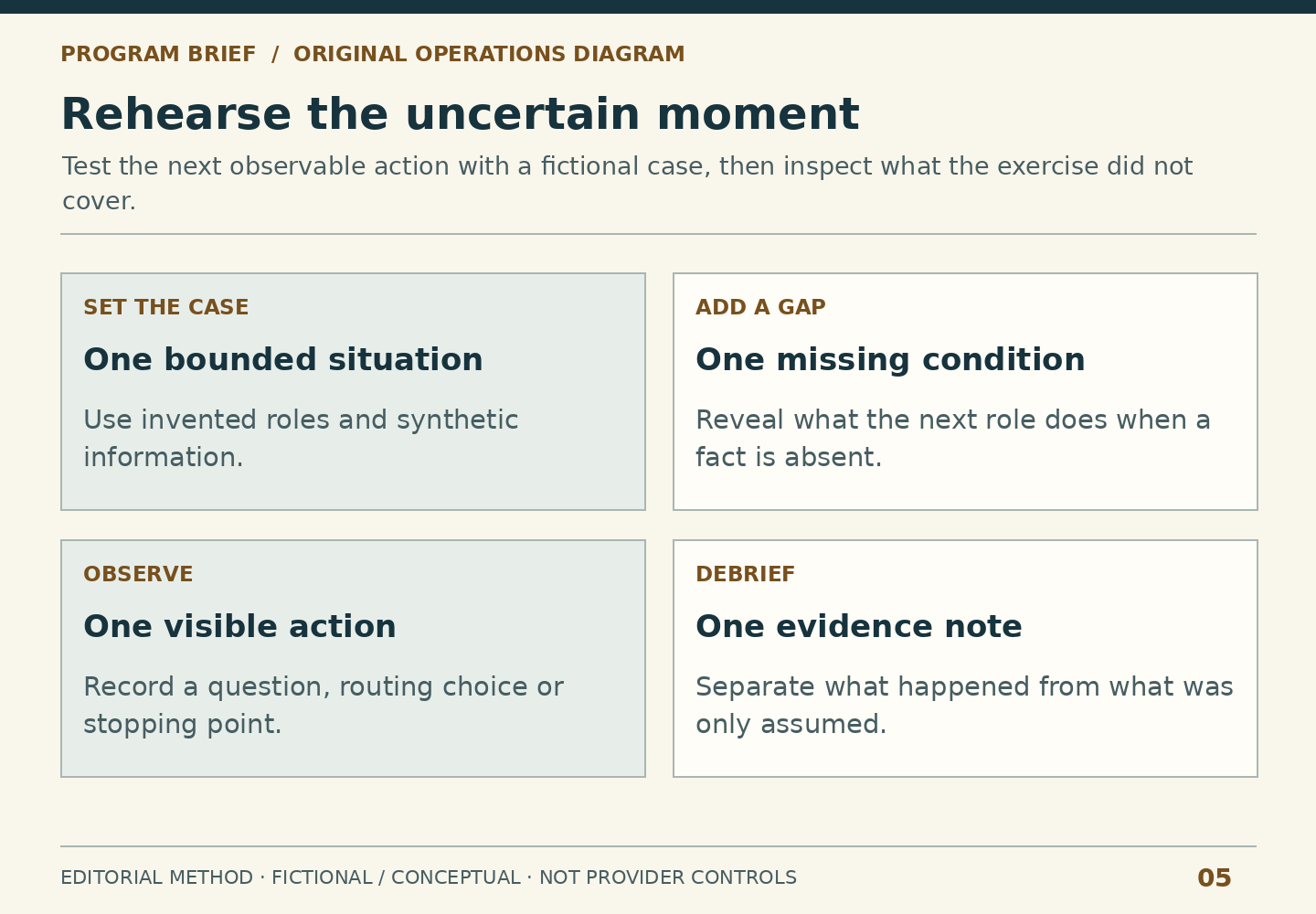
For a Corpay Prepaid project, the official PayCard page identifies the product context. It does not supply the employer’s incident script. Build this exercise from the organization’s verified responsibilities and approved contacts. The scenario below is fictional and does not describe a provider outage, a specific system status or an actual payment process.
Choose one uncertainty with operational consequences
Beacon Assembly is a fictional manufacturer preparing its rollout team. Its exercise begins with a narrow problem: an expected internal acknowledgment has not appeared before a planned checkpoint. The sender believes its task is complete. The receiving team’s usual contact is unavailable. A site manager asks whether the employer can tell employees that the next step is confirmed.
The facilitator does not announce that a payment failed or that the provider caused a delay. Those conclusions are not established. The exercise tests whether the team can hold the uncertainty accurately, find the right evidence and avoid turning an internal assumption into an employee-facing promise.
Write the exercise boundaries first
Label every document “exercise” and use fictional names and references. Specify that participants will not send live files, change payroll instructions, access employee accounts or contact external parties unless a separately approved testing arrangement explicitly calls for it. The default tabletop can be completed through discussion and prepared mock records.
Assign a facilitator, an observer and participants representing the employer roles involved. The facilitator controls new information. The observer records decisions and their supporting evidence. Participants respond as they would at work, using their approved reference materials and escalation plan. If the exercise reveals a real issue, pause the simulation and route the actual issue through the established process.
Release information in three rounds
- The missing acknowledgment: Provide the sender’s internal completion note and the absence of the expected response. Ask the team to identify what is known, what is unknown and which role owns the next verification step.
- The conflicting interpretation: Add a manager’s message saying that someone heard everything was finished. Ask whether this changes the evidence and what the team can responsibly communicate.
- The partial update: Provide a mock response confirming only one part of the handoff. Ask which questions remain open and whether the planned checkpoint can proceed under the employer’s approved decision rules.
Do not design the exercise as a trick. Tell participants that some information will remain unresolved. The goal is to observe disciplined decisions, not to reward whoever guesses the hidden scenario fastest.
Ask for a decision statement after each round
A useful statement has four parts: current evidence, unresolved fact, assigned next action and communication boundary. Beacon’s team might say, “We have confirmation of our internal preparation step. We do not yet have the acknowledgment required for the next checkpoint. The designated receiving owner or backup will verify it through the approved route. We will not describe the later step as confirmed until that evidence is available.”
This wording is illustrative. The actual response depends on the employer’s process and obligations. The point is that the team states the limits of its knowledge without abandoning responsibility. “Waiting” is not a complete plan when no one owns the next check.
Observe the hidden shortcuts
The observer should watch for common shortcuts: treating an email as acceptance, assuming silence means success, asking an employee for private account evidence to resolve an employer-process question, or using a senior person’s confidence as a substitute for verification. Record the action and context, not a verdict about the participant.
Also note constructive behavior. Someone who spots that the backup contact is missing from the approved directory has identified a practical defect. Someone who narrows a broad question to the exact missing acknowledgment has reduced unnecessary investigation. These observations can improve the runbook before real pressure arrives.
Debrief into changes with owners
Beacon’s debrief produces three findings: the acceptance signal was poorly defined, the receiving backup was unclear and the manager’s update template blurred “prepared” with “confirmed.” Each finding becomes a specific correction with an owner and a way to test it. The team repeats the relevant round after updating the materials, rather than repeating the whole meeting unchanged.
Keep the exercise record free of invented claims about provider performance. It should say what the employer tested and learned. A successful tabletop demonstrates that people can follow a decision process under a defined scenario; it does not prove that a live rollout will have no errors.
Know when the rehearsal is finished
Close when the significant defects have been assigned, the revised critical steps have been demonstrated and any unresolved dependency is visible to the launch decision owner. Do not mark the exercise complete solely because the meeting ended. Its value is the improved employer behavior that survives after the fictional scenario is put away.
Source boundary
These are original editorial methods and fictional examples, not provider instructions or launch approval. Public sources supply the narrow product or general-practice context identified beside the linked claim.
- Corpay PayCard product overview · checked October 13, 2026