In this article
A launch review should end with a decision that someone outside the meeting can understand. “Looks good” is not enough. It does not say what scope was approved, which evidence mattered or what happens if an unresolved condition remains open. The useful outcome is a short record that connects the decision to the employer’s actual readiness evidence.
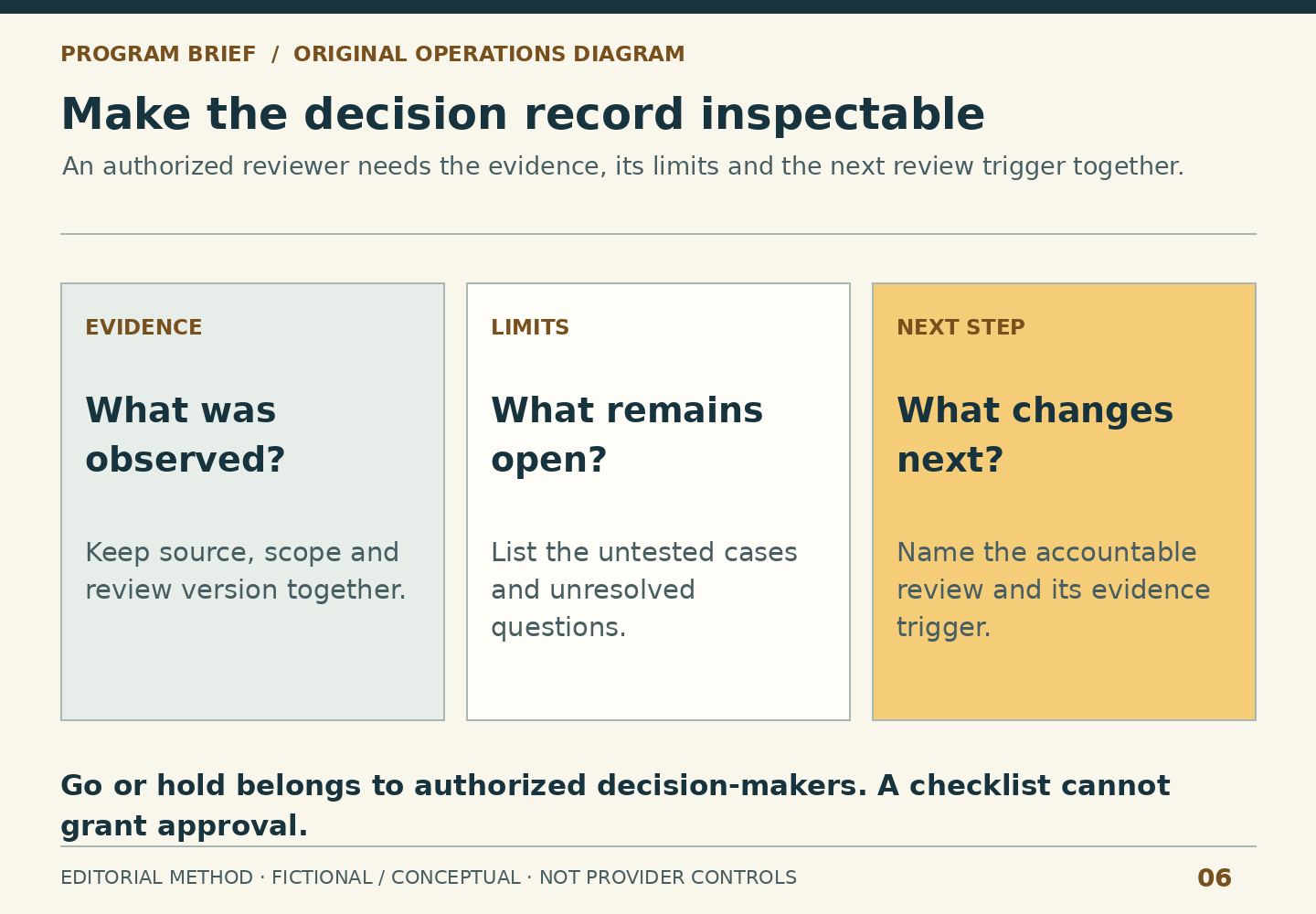
This is a program-management method for employer teams. It is not a provider approval, a legal conclusion or a promise that a rollout will be error-free. Use the applicable Corpay materials, including the official PayCard information where relevant, alongside the employer’s verified implementation records. Do not treat a public overview as evidence that this employer has completed its preparation.
Bring the decision boundary to the first page
Glenmere Hospitality is a fictional employer with several properties. Its central team has completed the proposed program brief and reviewed communication materials. One property has not demonstrated coverage for an important local handoff. The sponsor asks whether the company is ready. The answer depends on whether “the company” means the full proposed scope or only the properties with established readiness.
The meeting pack begins with the decision being requested: approve the named first phase, narrow that phase or hold it pending specified evidence. It lists the locations and employer activities covered. It also identifies decisions that remain outside the meeting, including any specialist determinations or program approvals that must be obtained through their proper routes.
Ask for evidence by operating question
Organize the pack around the questions the decision owner needs answered. Is the scope still accurate? Are critical employer responsibilities accepted? Do the approved notices describe the actual process? Can staff perform the defined tasks? Have data routes received the required review? What did the rehearsal reveal, and which findings remain unresolved?
For each question, include the current conclusion, a concise supporting observation and the location of the authorized evidence. Avoid attaching a large collection of files without explaining what they establish. A reviewer should not have to reconstruct the project from meeting minutes to discover that a critical backup role remains unassigned.
Distinguish a defect from an acceptable follow-on task
Some unfinished work may be compatible with a bounded decision. Other unfinished work undermines the proposed scope. The difference should be assessed by the authorized decision owner using criteria agreed before the meeting. A cosmetic formatting improvement and an unapproved employee instruction are not equivalent simply because both appear on the same task list.
Use a short impact statement for each open item: what outcome could be affected, which part of the scope depends on it and what evidence would resolve it. Avoid generic labels such as “low risk” without an explanation. Where the consequence cannot yet be assessed, identify the missing fact and the reviewer responsible for evaluating it.
Consider three clear decisions
- Proceed within the stated scope: The required evidence has been reviewed and the decision owner authorizes the defined next step through the employer’s process.
- Proceed with a narrower scope: A specific population, location or activity remains outside the approval until its dependencies are resolved.
- Hold the proposed step: The record identifies the blocking condition, its owner and the evidence needed for reconsideration.
These are editorial labels for a decision record, not official Corpay statuses. Use the organization’s own terms if they are clearer. What matters is that each decision states exactly what is authorized and what still requires a decision.
Be careful with conditional approval
“Go, provided everything is fixed” can be indistinguishable from no decision at all. If the employer uses conditional approval, state who verifies the condition, what evidence they need and whether a further approval is required before the dependent step occurs. Do not leave the operational team to infer that a task marked complete automatically satisfies the sponsor’s condition.
At Glenmere, the unprepared property remains outside the initial phase. Its local owner must demonstrate the required handoff coverage, and the designated reviewer must confirm the evidence before a separate decision is made. The other properties do not inherit an unresolved condition that belongs to this one location.
Use the meeting to resolve disagreements in interpretation
If one team calls a rehearsal successful and another says it left a critical gap, ask what each statement refers to. The first team may mean that every planned topic was discussed; the second may mean that an essential action was never demonstrated. The review should clarify the standard and the observation, not settle the issue through seniority or enthusiasm.
Record material dissent or uncertainty in neutral terms. A decision can acknowledge a limitation without pretending that everyone interpreted the evidence identically. Where the disagreement concerns facts, assign the verification. Where it concerns an authorized judgment, make the accountable decision explicit.
The record someone can use tomorrow
A durable decision note includes the decision date, exact scope, accountable decision owner, evidence reviewed, unresolved limitations, conditions and next review trigger. It also names the person responsible for communicating the approved outcome to operating teams. Store supporting records according to the employer’s policies and avoid copying personal account information into the summary.
Glenmere’s note explains why the first phase is narrower than originally proposed and what the excluded property must establish. The next manager can read it without attending the meeting and know what work is permitted, what remains open and who owns the next decision. That is the practical test of a launch review: it creates a clear operating boundary that survives beyond the conversation.
Source boundary
These are original editorial methods and fictional examples, not provider instructions or launch approval. Public sources supply the narrow product or general-practice context identified beside the linked claim.
- Corpay PayCard product overview · checked October 13, 2026