In this article
Most rollout plans already have a list of responsible departments. Fewer explain what happens in the ten minutes when work leaves one department and has not yet been accepted by the next. Those gaps matter. A supervisor can truthfully say an issue was sent while payroll can truthfully say it never received an actionable request. A handoff agreement makes the transition explicit.
This article offers an employer-side planning method for a prepaid program. It does not describe Corpay’s internal support model or grant anyone authority over an individual account. Use the official PayCard page as product context, then establish the actual provider contact routes and boundaries from the program materials supplied to the employer.
Find transitions rather than departments
At fictional Westhaven Packaging, the project chart says that human resources owns employee communications and payroll owns payment questions. Overnight supervisors receive both kinds of questions, often while the other teams are unavailable. A supervisor writes “sent to payroll” in a shift log. Payroll later discovers a message without the employer reference needed to locate the issue. The question was transmitted, but the work was never accepted.
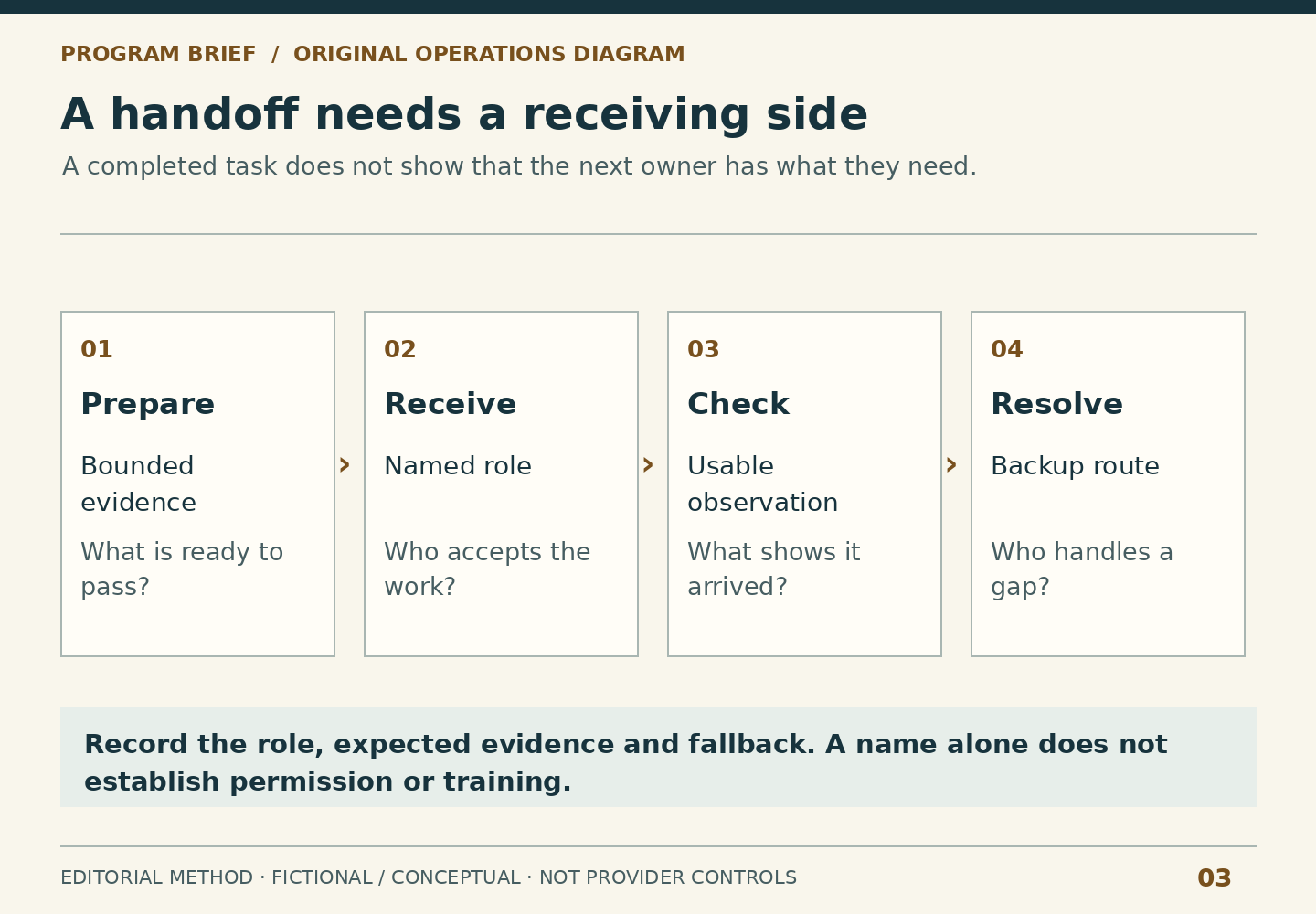
The project lead maps four employer transitions: an approved notice moves to the site manager for distribution; a staff question moves to the designated intake role; a request needing specialist judgment moves to its reviewer; and a resolved answer moves back to the employee-facing team. None of these transitions requires the project lead to collect account credentials or cardholder transaction details.
Start with transitions that can delay an important next step. Do not map every email. A useful test is whether the receiving team could reasonably believe it is waiting for something the sending team believes it has already completed.
Give a handoff six concrete parts
- Trigger: What observable event starts the handoff?
- Sender: Which employer role prepares the request?
- Receiver: Which named role accepts responsibility for the next step?
- Minimum packet: What nonsecret information is needed, and where does restricted information belong if it is genuinely required?
- Acceptance signal: How does the sender know that the receiver has accepted the work?
- Coverage and escalation: What happens if the receiver is absent, the request is incomplete or the next action cannot wait?
A shared mailbox can be a destination without being an owner. If a mailbox is part of the approved process, name the role that monitors it and define coverage. Avoid inventing a response promise simply to fill the chart. The team should choose an internal service expectation it can actually staff, while recognizing that applicable payroll or program obligations may require separate specialist attention.
Separate information from authority
Westhaven’s frontline supervisors need enough knowledge to identify the right route. They do not need permission to change payroll instructions or investigate card accounts. Its handoff agreement therefore distinguishes three actions: explain approved employer information, gather the minimum facts for an employer-side question, and refer a cardholder to the verified official channel for account-specific assistance.
This prevents helpfulness from expanding into unauthorized handling. A supervisor can say, “I can help identify the employer contact for that question,” without asking the employee to display a balance or hand over a phone. Likewise, an internal reviewer can determine that an employer record needs examination without assuming that the provider caused the problem.
Test ownership with an absence
Read the draft agreement as though the usual expert is on leave. Can a backup identify the request type, access the approved internal material and tell the sender what happens next? If the answer depends on personal memory or a private chat history, the handoff has a hidden single-person dependency.
Westhaven assigns a role-based backup for the overnight intake path and rehearses one incomplete request. The backup returns it through the agreed route with a precise missing-information question. The record remains open rather than appearing resolved because someone replied. This distinction helps both teams understand who currently has the next action.
Use a small status vocabulary
Choose statuses that describe responsibility, not optimism. “Prepared,” “received for review,” “waiting for specified information,” and “next action assigned” are more useful than “handled.” Define them in the employer’s own workflow. Do not imply that these labels are provider-system statuses or that an internal completion label confirms funds availability.
A closure note should state the employer task completed and any continuing responsibility. For example, the team may have corrected its own communication and directed a separate account question to official support. Closing the communication task does not mean the account question has been resolved. Keep those outcomes distinct.
The handoff card
For the overnight scenario, Westhaven’s card reads: “When a supervisor receives an employer program question, use the approved intake route with the location, issue category, relevant employer reference and requested next step. Do not include authentication information. The assigned payroll or human-resources intake role acknowledges ownership. An incomplete request stays with the named sender until the missing fact is supplied through the approved channel. Urgent concerns follow the separately verified escalation path.”
Every organization will need different wording and specialist review. What matters is that the sending and receiving roles can both explain the agreement the same way. Once they can, the responsibility chart has become a working process rather than a list of department names.
Source boundary
These are original editorial methods and fictional examples, not provider instructions or launch approval. Public sources supply the narrow product or general-practice context identified beside the linked claim.
- Corpay PayCard product overview · checked October 13, 2026